

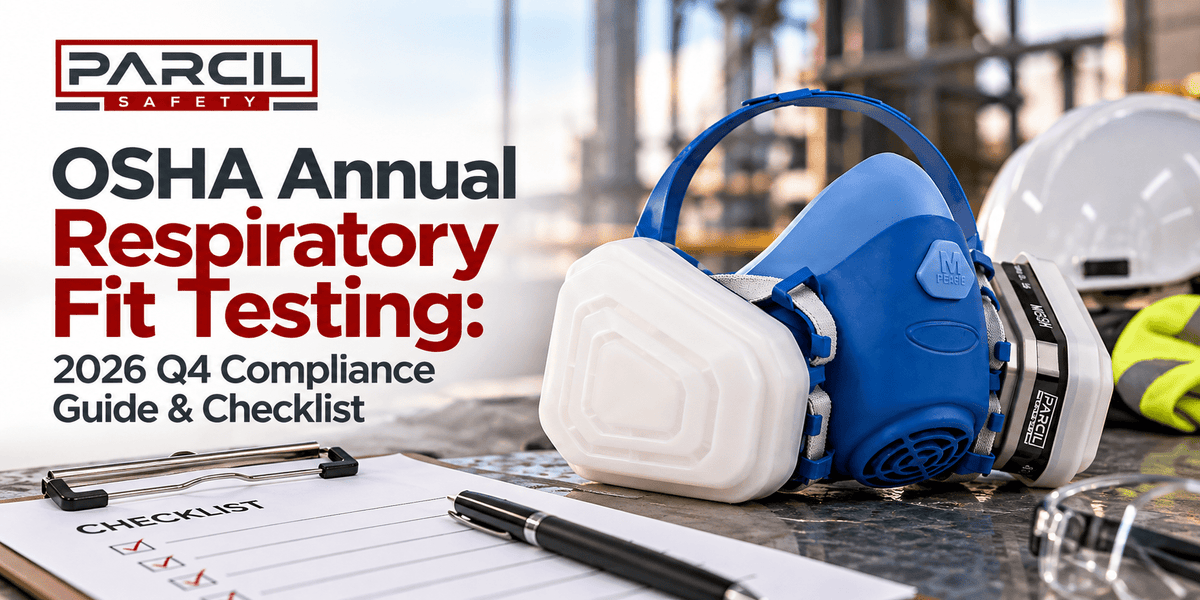
As the fourth quarter draws to a close, safety managers and industrial facility directors face a familiar end-of-year milestone: auditing occupational health programs to ensure complete regulatory compliance before annual inspections. At the top of that Q4 checklist is OSHA Standard 29 CFR 1910.134—specifically, the mandatory requirement for annual respiratory fit testing.
Failing to complete annual fit testing not only opens your facility to costly OSHA citations during end-of-year audits, but it also puts your workforce at risk of acute and chronic chemical exposures. Here is everything you need to know to execute a seamless Q4 fit-testing audit, verify your gear, and ensure full compliance heading into 2027.
Explore Industrial-Grade Gas Masks HereUnderstanding OSHA Fit-Testing Requirements
OSHA requires that any worker mandated to wear a tight-fitting respirator must undergo a fit test before initial use and at least annually thereafter. A proper fit test verifies that the respirator facepiece forms an airtight seal against the wearer’s face, preventing hazardous chemical vapors, toxic gases, and particulates from bypassing the filter media.
Key OSHA Standard 1910.134 Mandates:
- Annual Recertification: Fit testing is not a one-and-done event; it must be repeated every 12 months.
- Make, Model, and Size Specificity: A worker must be tested with the exact make, model, style, and size of respirator they will use on the job. Swapping brands or mask sizes requires a new fit test.
- Medical Clearance First: Before a worker can undergo a fit test, they must receive written medical evaluation clearance from a licensed healthcare professional.
- Facial Hair Policy: OSHA strictly prohibits any facial hair that lies along the sealing surface of the respirator, as even light stubble breaks the gas-tight seal.
Qualitative vs. Quantitative Fit Testing: Which Do You Need?
Depending on the concentration of contaminants and the type of mask used in your workplace, OSHA allows two primary fit-testing methods:
1. Qualitative Fit Testing (QLFT)
How It Works: A pass/fail test that relies on the wearer's sense of taste or smell using a test agent (such as Bitrex, saccharin, or isoamyl acetate smoke) inside a testing hood.
When It's Used: Approved primarily for half-face respirators and full-face respirators used in lower-concentration environments (where required protection factors are 10 or less).
2. Quantitative Fit Testing (QNFT)
How It Works: Uses ambient particle counting instruments (like a PortaCount machine) to numerically measure leakage into the facepiece, producing a specific "Fit Factor."
When It's Used: Required for full-face respirators used in higher-hazard environments where a Fit Factor of 500 or greater is necessary to ensure safety.
Shop Respiratory Protection HereStep-by-Step Q4 Respiratory Fit-Testing Protocol
Use this practical step-by-step protocol to audit your facility's respiratory protection program before Q4 closes:
- Verify Medical Records: Confirm that all team members assigned to wear respirators have an up-to-date medical clearance on file.
- Inspect Facepiece Integrity: Before testing, check facepieces for cracked seals, stretched head harnesses, or damaged inhalation/exhalation valves.
- Enforce Clean-Shaven Policy: Ensure workers have no facial hair along the sealing perimeter prior to testing.
- Conduct Proper Sizing & Testing: Perform the QLFT or QNFT test using the exact mask make, model, size, and filter combination the employee will use on the job.
- Document and Retain Records: OSHA requires written fit-test records containing the employee’s name, test date, mask make/model/size, testing method, and pass/fail results. Keep these records readily accessible for inspection.
Equipping Your Team for OSHA Compliance with Parcil Safety
Selecting reliable, certified equipment makes compliance straightforward and ensures your team passes fit testing on the first attempt. Parcil Safety offers respiratory solutions designed around strict international and US safety standards.
1. UltraSeal T-71 Half-Face Respirator (NIOSH-Approved)
For standard industrial chemical handling, paint spraying, and organic vapor hazards where a half-mask system is required, the Parcil Safety T-71 UltraSeal delivers NIOSH-certified protection (paired with ProGuard OV/P95 cartridges).
- Guaranteed OSHA Compliance: Official NIOSH approval (TC certification) satisfies OSHA workplace requirements for mandatory respiratory programs.
- Ergonomic Seal: Dual-silicone seal conforms comfortably to a wide range of facial structures, maximizing qualitative and quantitative fit-test pass rates.
- Low-Profile Design: Integrates smoothly with safety glasses, face shields, and hard hats.
2. ST-100X Full Face Respirator Gas Mask
When hazards involve harsh lacrimating vapors, chemical splash risks, or intense eye irritants, half-masks are insufficient. The ST-100X Full Face Respirator combines comprehensive airway protection with an integrated 200° panoramic face shield.
- Panoramic Ocular Protection: Shields eyes against liquid splashes, mist, and irritating vapors.
- Heavy-Duty Silicone Seal: Designed for maximum seal integrity during extended shifts and rigorous physical work.
- Flexibility: Compatible with standard 40mm filters and bayonet cartridges, making it an essential asset for emergency hazmat caches.
Close Out Q4 with Confidence
A compliant respiratory protection program protects your workers from hazardous exposures and protects your business from regulatory fines. Take time this Q4 to review your records, conduct required fit testing, and replace worn gear or expired filter canisters.
Explore Industrial-Grade Gas Masks Here
Leave a comment
All comments are moderated before being published.
This site is protected by hCaptcha and the hCaptcha Privacy Policy and Terms of Service apply.